Business Communication Instruction shares the latest news, tips, techniques, and methods being used by instructors today to make their classes more rewarding and enjoyable.

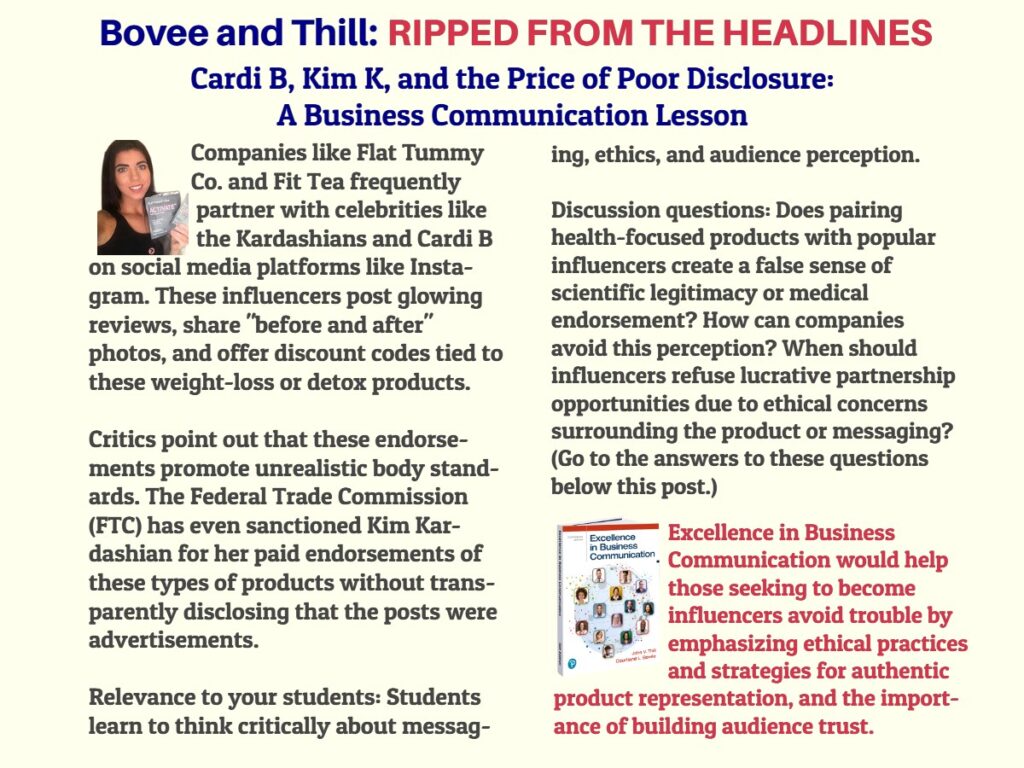
Cardi B, Kim K, and the Price of Poor Disclosure: A Business Communication Lesson

ANSWERS:

Here's a breakdown of the questions and how to approach answers, considering some ethical complexities involved:

Question 1: Does pairing health-focused products with popular influencers create a false sense of scientific legitimacy or medical endorsement?

Yes, it often can. Many influencers don't have qualifications in health, nutrition, or medicine. Their popularity arises from other factors (aesthetics, entertainment value, etc.). When they promote health products, it can mislead audiences into thinking there's more scientific backing than there is.

The "Halo Effect": We trust people we like or find attractive. Their presence alongside a product makes us favorably disposed towards it, even without solid evidence.

Companies intentionally do this: They know influencers will boost sales even if the influencer lacks genuine expertise.

Question 2: How can companies avoid this perception?

Transparency: Clear disclaimers that an influencer is not a medical professional, and their statements shouldn't replace advice from a doctor.

Vetting: Work with influencers who align with evidence-based health practices. Someone selling detox teas is probably not a great choice if a company truly cares about the science behind their products

Tone Down Claims: Instead of making big promises, focus on how a product might fit into a balanced lifestyle. Avoid sounding like the influencer is prescribing medication.

Question 3: When should influencers refuse lucrative partnership opportunities due to ethical concerns surrounding the product or messaging?

This is a personal line each influencer must draw, but here are situations where refusal is likely warranted:

Conflicts of Interest: If the product goes against the influencer's normally stated beliefs (e.g., a vegan influencer promoting a meat-heavy diet for money).

Dishonesty: When the influencer knows the claims about the product are deceptive or exaggerated.

Potential Harm: If there are known risks associated with the product, especially if the influencer's followers are a particularly vulnerable demographic.

Gut Feeling: If something makes them genuinely uncomfortable, even if they can't pinpoint the exact reason, sometimes listening to one's internal ethical compass is necessary.

Additional Thoughts

Regulation is lacking in this space, allowing dubious practices to continue. Consumers and influencers themselves need to be aware of these marketing tactics.

Critical thinking is needed by consumers. Don't trust health claims from someone just because they're famous or look fit.

Fame doesn't equal knowledge. A huge following does not equal medical expertise.

By dissecting real-world situations like these, and as in done in Excellence in Business Communication, 14th Edition, business communication students learn to think critically about messaging, ethics, and audience perception. They recognize the power of persuasive techniques and identify instances where those techniques cross into manipulation. Analyzing "ripped from the headlines" scenarios demonstrates the real risks when communication goes wrong, preparing students to become thoughtful and responsible communication professionals.

————————————————————————————————————————————————————————-

Subject: Spark Student Interest in Business Communication with "Ripped from the Headlines" Discussions

Dear Business Communication Instructor,

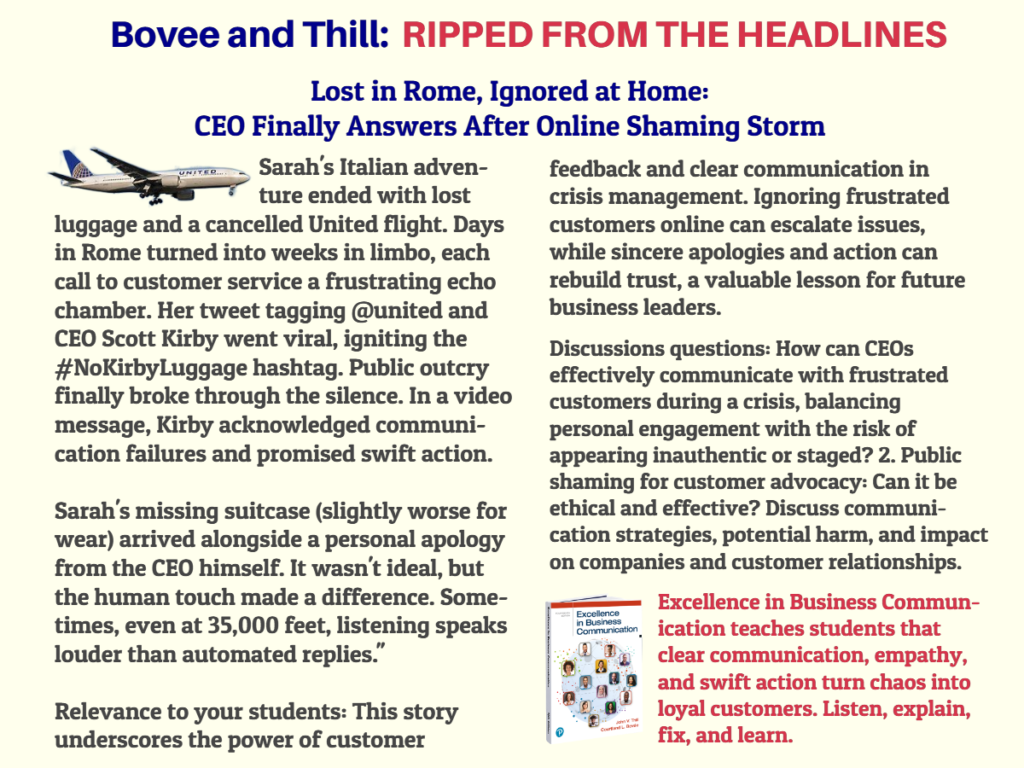
Want to prove your subject matter isn't just theory? This newsletter links your lessons to THIS WEEK'S news – crisis communication fails, deepfakes, AI blunders, and more. It's packed with ready-to-use talking points to show students how their business communication skills will be essential in their future careers.

This headline supercharges student motivation with these key strategies:

Extrinsic Motivation: It directly links course material to potential career consequences, acting as an extrinsic motivator. Students understand that business communication isn't just about grades, but about real-world success.

Intrinsic Motivation: Analyzing current events and engaging in lively discussions fosters intrinsic motivation. This makes learning enjoyable and builds a positive association with the subject matter.

Relevance-Based Motivation: Demonstrating how current headlines relate to core concepts enhances motivation. Students see the subject as important and timely, boosting interest and engagement.

Need to streamline your lesson planning? This newsletter does the prep work for you! Each story links to a key business communication concept and includes thought-provoking discussion questions. We hope this makes your classes the ones students can't stop talking about!

This dynamic teaching is made possible with Excellence in Business Communication, a textbook that stands out with its unmatched focus on real-world skills and the rapidly evolving digital landscape. It features current headlines, explores the complexities of AI and deepfakes, and prioritizes ethical, adaptable communication in a way no other textbook does.

This contemporary approach means students won't just learn theories–they'll tackle the problems facing today's businesses. Emphasis on critical thinking and audience analysis prepares them to adapt to communication challenges on the horizon. With "Excellence," lessons transcend the classroom, ensuring graduates enter the workforce with a competitive edge.

The emphasis on building trust and authenticity in this era of heightened skepticism reinforces the value of true connection alongside technological efficiency. This is why Excellence in Business Communication is being so widely adopted by business communication instructors in 2024.

See the brochure for Excellence in Business Communication, 14th Edition: Video: . How Does Your Text Compare? . To request examination copies of Bovee and Thill's award-winning business communication textbooks (instructors only), visit this ordering page.

Read more

Generative AI in the Business Communication Curriculum: Where Do We Go From Here?

As we’ve been tracking the development of intelligent communication technologies in our recent editions, augmented and automated writing systems have been the most intriguing innovation of them all. ChatGPT received most of the attention when OpenAI unleashed it on a mostly unsuspecting world last fall, but several hundred companies are now developing tools that promise to create or co-create anything from routine email messages and social media content to podcasts, presentations, and videos.

While the AI industry is clearly in the overheated early-hype phase with some of these products, intelligent capabilities are now widely available in the mainstream tools people use on the job, so it’s safe to say that generative AI technologies are on their way to becoming everyday business communication tools. With that in mind, it’s time to start teaching tomorrow’s professionals how to use them effectively and ethically—as we know many of you are already doing.

Looking ahead to the next edition of Business Communication Today we’ll be working on in the coming months, which topics would you like to see us cover? Here are some of the topics we’re considering:

  • Understanding the various roles that AI now has in workplace communication
  • Using AI efficiently, including tips on framing AI prompts
  • Learning specific ways to use AI for business communication, from co-creation to proofreading to technical aspects of media production
  • Assessing information quality risks with AI-generated material, including accuracy (getting bad information), scope (missing important facts or facets of a topic), currency (getting outdated information), and nuance (getting output that is close but lacks important interpretation)
  • Understanding ethical risks, including biases baked into AI systems and attribution issues surrounding the use of AI-generated content
  • Understanding legal risks, such as misusing intellectual property or inappropriately uploading secure content into AI engines
  • Dealing with the “soullessness” of AI-generated content and its potential impact on interpersonal communication

If you have any thoughts on how our textbooks can help you help students with these new tools, we would certainly value your input. Please share your thoughts at any of these venues:


Image by MOMO36H10 HH from Pixabay 

Read more

16 Dangerous Practices to Avoid When Writing for Business

writing concerned about his business writing

Here are ten of the most important findings that research has discovered about written business communication:

Email Length: Shorter emails tend to be more effective than longer ones in businesses, which leads to better email response rates and improved workplace efficiency.

Tone and Style: Professional tone, coupled with an individual writing style, establish a company's voice, captivates the reader, and conveys confidence when deploying certain communicative styles.

Audience Awareness: Understanding the target audience, their preferences, and needs helps businesses determine the tone, style, and format for their communication, which can enhance readability, understanding, and engagement from the audience.

Active Voice: Active voice provides clear and concise language, making communication more engaging and memorable.

Politeness and Persuasion: Politeness in written business communication, such as the use of please and thank you, can enhance persuasion, increase the likelihood of positive feedback, and foster improved business relationships.

Visual Appeals: Visuals like graphics, images or tabled data make the content interesting and easier to understand and retain.

Brevity: The use of simple language, bullet points, and emphasis on collaboration saves time, enabling more efficient and effective communication and reduces the chances of miscommunication.

Framing: Strategic and discreet framing techniques can emphasize important information, key points and redirect focus when necessary towards significant goals.

Making a Human Connection: Businesses communicating with their audience in a personalized and friendly tone, uses in-joke, or humor can create a sense of relatability and human connection with your audience resulting in better communication and stronger relationships.

Call-to-Actions: Including clear and effective calls-to-action drives engagement, workflows, and encourages interactions between business and its audience or prospects.

These findings offer businesses insights into how written communication can be used to engage, persuade, and build healthy relationships with their audience and stakeholders.

Comprehending the strategic use of language to persuade and engage customers and partners has become more crucial in the modern business landscape than ever before. By paying attention to important elements like language, tone, structure, audience specificity, and visuals, businesses can have a better chance of creating that level of engagement, driving results, fostering goodwill, and keeping communication lines open.

For further information about the leading textbooks in business communication, visit http://blog.businesscommunicationnetwork.com/texts

Read more

Instructors and Students Nationwide Love Bovee and Thill’s Business Communication Textbooks

Instructors and students nationwide love Bovee and Thill's award-winning business communication textbooks.See the more than 55 cities featured on this page.

Bovee and Thill's texts are the most widely adopted business communication textbooks in the world. Request examination copies of these award-winning textbooks today! (Instructors only.)


See details:

Teach Your Students What to Do When Colleagues Don’t Read Anything They Write. Here Are 8 Ways to Change That.

Long emails and dense, difficult to decipher memos mean modern office communication goes ignored more often than it’s understood.

Sourced through Scoop.it from: www.nytimes.com

Read more

The 5 Hottest Communications Trends for 2020

"For corporate communications professionals this is a good opportunity to look at what’s happening across the industry to determine what could be adopted – or removed – from your communications repertoire next year in order to communicate with your external and internal stakeholders efficiently and effectively.


"Here are some of the top corporate communications best practices you can incorporate in your workplace in 2020:"


Sourced through Scoop.it from: www.alert-software.com

Read more

How Artificial Intelligence (A.I.) Is Transforming Business Communication

"From chatbots to targeted marketing campaigns, A. I. is quickly changing the way businesses communicate both internally and externally.


"Contrary to popular belief, A.I. is not a monolith, but actually a group of technologies, like machine learning, natural language processing, and predictive analytics.


"In this article, we look at specific A.I. applications that have revolutionized business communication."

Sourced through Scoop.it from: voymedia.com

Read more

A Message from Court Bovee and John Thill

We hope the new year and your current term are off to a successful start. Once again, we would like to salute your efforts in helping students get ready for the communication challenges and scenarios they will face on the job.

With every new edition of the three titles in the Bovée-Thill business communication series, we look for opportunities to add topics and features to help you in this important effort—and to make the course as satisfying, entertaining, and successful as possible.

Following on the recent launch of the Fifteenth Edition of our flagship text, Business Communication Today, this feels like a great time to highlight some of the advances in our texts that help students get ready for the practices and expectations of today’s digital workplace.

Continuing our record of introducing major technological breakthroughs to the business communication course, our newest editions explore the exciting—and occasionally daunting—changes being brought about by artificial intelligence.

We refer to these innovations as intelligent communication technology, and we explore a variety of systems that students are likely to encounter during their job searches and potentially use on the job. These include augmented writing, real-time translation, virtual teammates, smart listening systems, résumé bots, and AI-assisted interviewing. We’re fascinated by the impact these technologies are beginning to have, and we think you and your students will be too.

On the subject of technology, today’s students have plenty of experience with digital, social, and visual media, but as you know not all that experience translates well to the business world. Our texts show students how to apply what they already know about media usage—and which habits they need to develop or change to succeed as professionals. For instance, our highlight box on developing professional-grade email skills points out five choices that writers need to make to graduate from social email to “business class.”


Speaking of the ever-evolving digital workplace, our latest editions keep up with changing business practices and contemporary employer expectations to make sure students enter the workforce primed and ready. A good example of shifting and sometimes confusing standards is the vexing question of whether to use emojis. They are widely used (and often for good reason) but not universally accepted or universally appropriate, so we offer students in-depth advice on why and when they should consider using them.


In addition to covering emerging topics, we continue to add features to help you and your students. (These new features are available in Excellence in Business Communication 13e and Business Communication Today 15e.)

  • Build Your Career activities guide students through creating their employment-communication packages chapter-by-chapter throughout the course so they’re ready to apply for jobs by the end of the term.

  • Apply Your Skills Now highlight boxes help students apply communication skills they are learning in this course in their other classes and in their personal lives.

  • Five-Minute Guides serve as handy reminders of the steps needed to accomplish a variety of fundamental communication tasks, from writing business email to planning reports and presentations.

Here’s a video preview of our texts. If you haven’t already done so, we invite you to order review copies. Or click here to get in-depth information on all three titles or to catch up on the latest posts from our blog.


We wish you and your students a positive learning experience this year!

All the best,


Court Bovee
John Thill

Read more

“I’ve Tried Several Textbooks, and the Experience Revealed the Authors’ Biggest Mistake.”

The biggest mistake was insufficient revisions–a lack of focus on digital, social, mobile, artificial intelligence, and intelligence technology.


But there is one exception: Bovee and Thill provide full coverage of these topics in their texts.

Sourced through Scoop.it from: youtu.be

Read more

How to Explain Anything to Anyone: 4 Steps to Clearer Communication

"You’ve probably seen people’s eyes glaze over when you were talking about a complex topic, and you’ve done the same thing yourself. But that doesn’t mean some things are just too confusing to explain in a way that could be understood."

Sourced through Scoop.it from: ideas.ted.com

Read more
Page 5 of 28« First...34567...1020...Last »
1.43k